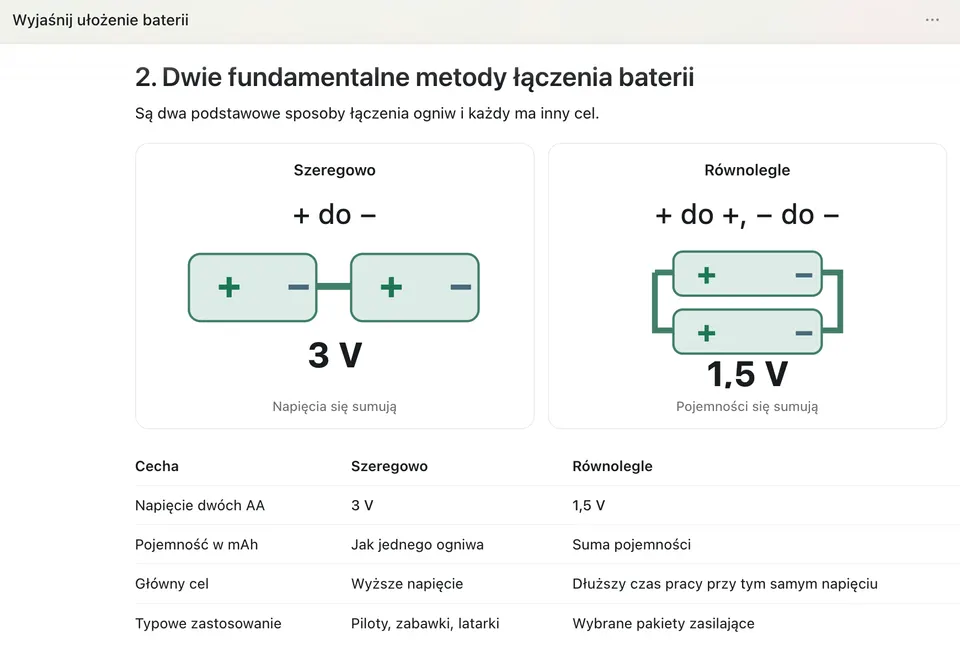
Today I was changing the batteries in my TV remote and realized that I don’t really understand why one battery goes in with the positive end facing up and the other with the negative end facing up.
I vaguely remember something from high school physics, but why does it actually work that way? What’s that little spring for? Why do batteries go in differently in some devices?
I asked ChatGPT to explain it to me and got an interesting explanation, complete with the history, exceptions, and a few fun facts.
It amused me a little that my brother Wiktor Kunke is an engineer and has worked professionally with batteries for many years. I’m convinced he could give me an eight-hour lecture on the subject.
But that’s exactly why I like tools such as ChatGPT. They help us better understand the world around us, even when we’re not experts in a particular field.
I’ve noticed that over the past 12 months, as AI’s capabilities have improved so much, I’ve started asking far more questions. Sometimes about batteries, sometimes about something I’d look up on Google, and sometimes about something I wouldn’t normally spend time on because it seems unimportant.
I think this is one of AI’s most underrated benefits. It doesn’t just help us work faster. It also makes it easier to be curious about the world.
Here’s the prompt I used, translated from Polish:
when you put batteries in, often one has the positive end facing up and another has the positive end facing down - explain this to me in detail, explain the principles, history, exceptions, and fun facts in a detailed, beautiful answer
As you can see, it wasn’t very elaborate.
For more interesting things about AI, follow ^Kunke Consulting and visit my website.